
What Happens at a Children’s Theatre Workshop? A Parent’s Complete Guide
- Sudhir Rana
- Mar 6
- 4 min read

You are considering enrolling your child in a theatre workshop but are not quite sure what it involves. Will they just be memorising lines? Is it like a school play? What if they are too young or too shy? This guide walks you through exactly what happens at a children’s theatre workshop at Pratham Path Theatre — session by session, skill by skill.
First Things First: This is Not a School Assembly
School annual day performances are typically rehearsed over a few sessions, focused on the final product, and dominated by a handful of confident students. A professional theatre workshop is fundamentally different. The focus is on the process — on building skills, growing confidence, and developing every child — not just preparing a show.
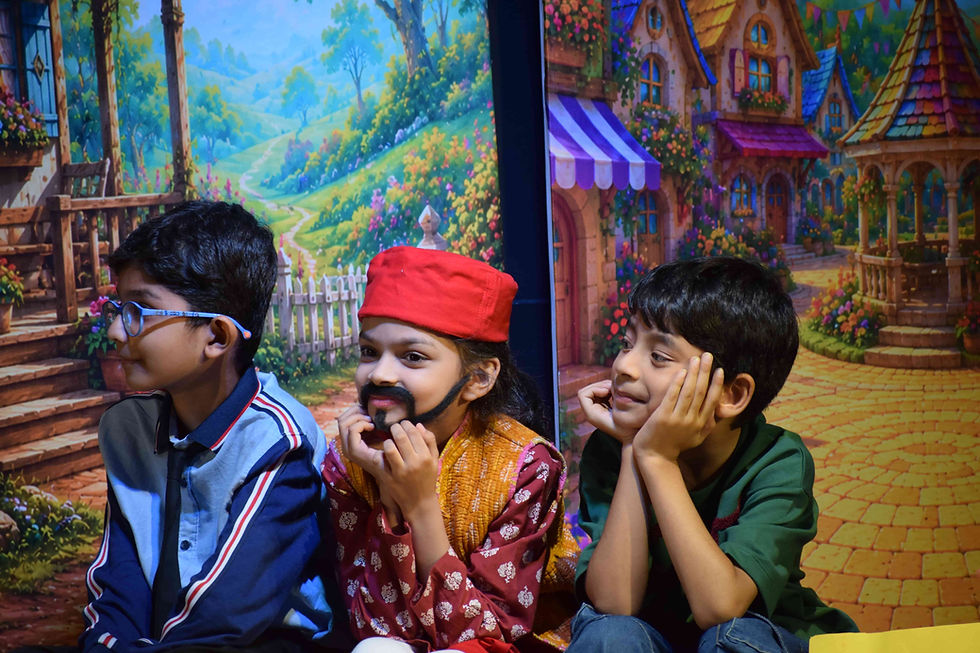
At Pratham Path Theatre, every child who joins the workshop will perform in the final production. Not as a background extra. Every child gets meaningful stage time with dialogues, movement, and purpose.
The Workshop Structure: 30 Sessions Over 3 Months
Our workshop runs twice a week — Saturdays and Sundays — for approximately 12 weeks. Each session is 90 minutes. Here is what a typical journey looks like:
Phase 1: Games, Trust, and Group Bonding (Sessions 1–8)
The workshop always begins with theatre games. These are structured activities designed to build trust, energy, and group bonding. Children run, jump, shout, laugh, freeze, and react — all within the framework of a game. There are no wrong answers. There is no judgement. The goal is simple: get comfortable, have fun, and start working together.
Common games include mirror exercises (copying a partner’s movements), zip-zap-zoom (a focus and reaction game), and storytelling circles (building a story one sentence at a time). These may look like play, but they are building foundational theatre skills: focus, listening, quick thinking, and physical awareness.
Phase 2: Voice, Body, and Expression (Sessions 9–14)
Once children are comfortable, we shift into skills training. This includes voice projection exercises (learning to speak loudly and clearly without shouting), speech clarity drills, facial expression work, and body language exercises.
Children also start doing short improvisations — unscripted scenes where they create characters and situations on the spot. This is where creativity explodes. A child might play a nervous dentist, an angry tomato, or a detective solving the mystery of the missing tiffin box. The scenarios are fun, but the skills being built — quick thinking, verbal fluency, confidence — are serious.
Phase 3: Script Work and Scene Building (Sessions 15–22)
This is where the final production begins to take shape. The director introduces the script — usually an original adaptation written specifically for the batch. Roles are assigned based on each child’s strengths and growth areas. Children learn dialogue delivery, stage blocking (where to stand and move), cue responses, and ensemble coordination.
At Pratham Path Theatre, scripts are designed to have 15–20 meaningful roles so that every child in the batch has substantial stage time. We use ensemble characters — villagers, courtiers, narrators, animals — creatively so that no child feels like a background prop.
Phase 4: Full Rehearsals and Production Week (Sessions 23–30)
The final phase is full production rehearsal. Children run through the entire play repeatedly, learning about stage discipline, timing, energy management, and teamwork. Props and costumes are introduced. The excitement builds. By the final sessions, children are focused, rehearsed, and genuinely ready.
The Grand Performance
The workshop ends with a real stage production performed for an audience of parents, family, and friends. This is a full theatre experience: stage lights, costumes, props, and a real auditorium. For many children, this is the first time they perform for a live audience in a proper theatrical setting. It is a moment they and their families remember for years.
What Skills Will My Child Gain?
By the end of 30 sessions, children show visible improvement in confidence and willingness to speak up, voice clarity and projection, creativity and imagination, teamwork and cooperation, emotional expression and empathy, focus and discipline, and stage presence. These are not just theatre skills — they are life skills that support children in school, social settings, and future careers.
Frequently Asked Questions
Does my child need prior experience? No. The workshop is designed for beginners. No audition, no prerequisites.
What if my child is very shy? Shy children often benefit the most. The structured games and gradual progression create a safe space for them to open up naturally.
What ages are suitable? Our Junior Batch is for Grade 3 and above. Our Senior Batch is for Grade 7 and above.
Will every child get a role? Yes. This is non-negotiable at Pratham Path Theatre. Every child performs with meaningful stage time.
Join the April 2026 Workshop
Our next workshop runs from 4th April to 21st June 2026 at Nehru World School, Shastri Nagar, Ghaziabad. Sessions are on Saturdays (4:30–6:00 PM) and Sundays (10:30 AM–12:00 Noon). The grand stage production is on 21st June 2026.
Fee: ₹12,500 for 30 sessions including the final production. Limited to 15–20 children per batch.
To register or ask questions, WhatsApp us at 9910166111.
— Sudhir Rana, Founder & Theatre Director, Pratham Path Theatre | 20+ years in theatre education | 900+ children trained | 75+ productions staged


Comments