
Why Every Child Deserves a Role — Not Just the Confident Ones
- Sudhir Rana
- Mar 20
- 2 min read

In most school plays, the same pattern repeats: the confident, outgoing child gets the lead role. The shy child stands in the back row. The quiet one holds a prop. And the child who desperately needs the experience of performing gets the least of it.
This is backwards. And it is the single biggest reason I run children’s theatre workshops the way I do at Pratham Path Theatre.
The Problem with How Most Schools Cast Children
School productions usually operate under time pressure. A teacher has 2–3 weeks to put up a show for annual day. The fastest way to get a decent performance is to give the speaking roles to children who are already confident speakers. The rest become trees, villagers, or the chorus that stands at the back swaying.
From the school’s perspective, this makes sense. From the child’s perspective, it sends a devastating message: you are not good enough to be seen.
What Happens When Every Child Gets a Real Role
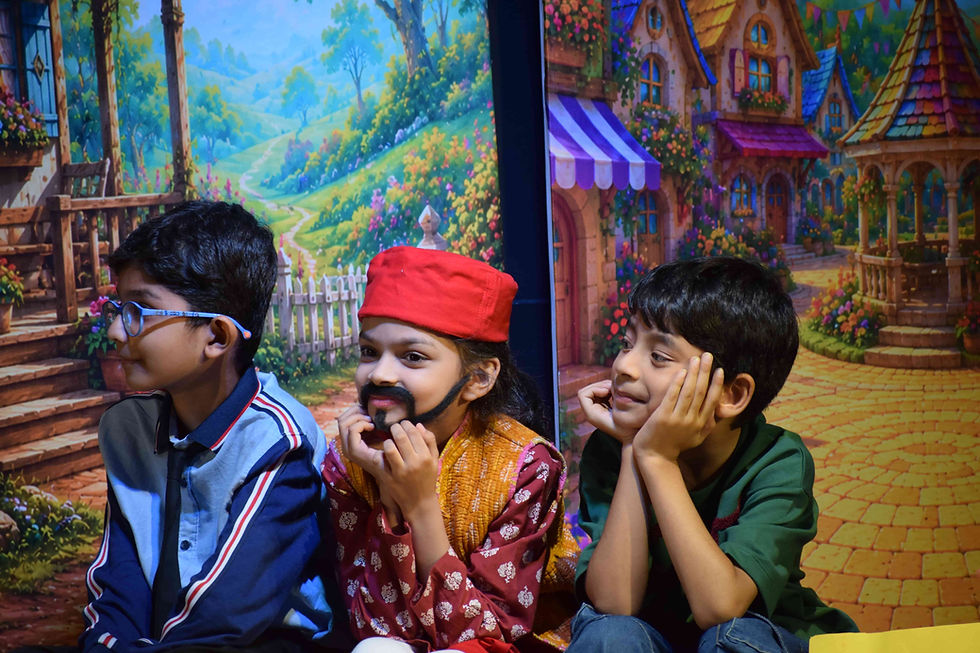
At Pratham Path Theatre, we operate on one non-negotiable principle: every child who joins the workshop performs in the final production with meaningful stage time, real dialogue, and genuine purpose in the story. No exceptions.
This means we write and adapt our scripts specifically for the batch. If there are 18 children, the script has 18 meaningful roles. If there are 22, the script expands. We use ensemble characters — villagers, courtiers, narrators, animals — but every ensemble character has lines, has moments, and has a reason to be on stage.
The result is remarkable. When a shy child delivers three lines to a live audience for the first time, the impact on their confidence is far greater than what any lead actor experiences. For the lead, performing is expected. For the shy child, it is a breakthrough.
How We Make It Work in 30 Sessions
The secret is time. School annual days are rehearsed in days. Our workshop runs for 30 sessions over three months. The first 8 sessions are theatre games and trust-building. The next 6 focus on voice and improvisation. Only then do we introduce scripts. By the time a child has to deliver a line on stage, they have already spent weeks building the skills and confidence to do it.
This is the fundamental difference between a theatre workshop and a school performance. We are not producing a show. We are developing performers.
A Message for Parents
If your child has ever come home from a school play feeling left out because they did not get a “real” role — our workshop is designed for exactly that child. We do not audition children. We do not sort them into leads and extras. Every child walks into our workshop with the same promise: you will be seen, you will be heard, and you will perform.
The April–June 2026 workshop at Nehru World School, Ghaziabad starts on 4th April. 30 sessions. Grand stage production on 21st June. Every child performs. WhatsApp 9910166111 or visit www.prathampath.com.
— Sudhir Rana, Founder & Theatre Director, Pratham Path Theatre | 27 years in theatre


Comments